
Bangalore
Batik Dyeing of Cotton With Reactive Dye
Learn the step-by-step process of batik dyeing on cotton using reactive dyes. Master vibrant, colorfast designs with this expert guide.
SohaniSharma
Theory
Batik is a process of using melted wax as a resist on fabric. In this technique, parts of the plain fabric are covered with wax, and then the cloth is dyed. The cloth is later boiled to remove the wax. The areas covered by wax retain their original color, thus creating beautiful designs.
{getToc} $title={Table of Contents}
Objectives
- To learn about the batik dyeing technique.
- To know about the procedure of batik dyeing.
- Learn about resist dyeing techniques.
Apparatus
- Pipette
- Weight Balancer
- Scissors
- Sample
- Dye pots, etc.
Recipe
Calculation
Sample fabric = 5 gm
So, Total liquor = (5 ✕ 20) = 100 ml
Dye:
100 gm fabric needed 3 gm of dye
So, 5 gm of fabric needed (3 ✕ 5) / 100 = 0.15 gm
Chemicals:
Salt = (20 ✕ 100) / 1000 = 2 gm
Soda ash = (5 ✕ 100) / 1000 = 0.5 gm
Wetting agent = (1 ✕ 100) / 1000 = 0.1 ml
Sequestering agent = (1 ✕ 100) / 1000 = 0.1 gm
CH3COOH = (1×100)/1000 = 0.1 ml
Total chemicals = (0.1 + 0.1) = 0.2 ml
Required freshwater = (100 – 0.2)= 99.8 ml
Working Procedure
- Fabric is weighted with a balancer and taken 5 gm.
- The prepared paste is applied to the cloth. Applied paste by block in specific areas.
- The calculated amount of chemicals and water is poured into the dye tube.
- Finally, the coated cloth is dipped in the dye tube.
- Dyed the fabric at 40℃ for 40 - 60 minutes.
- After dyeing, the coating is removed by hot wash and then washed with soap.
- Thus, the procedure is done.
Dyed Fabric Sample
 |
| Batik Dyed Fabric Sample |
Dyeing Curve
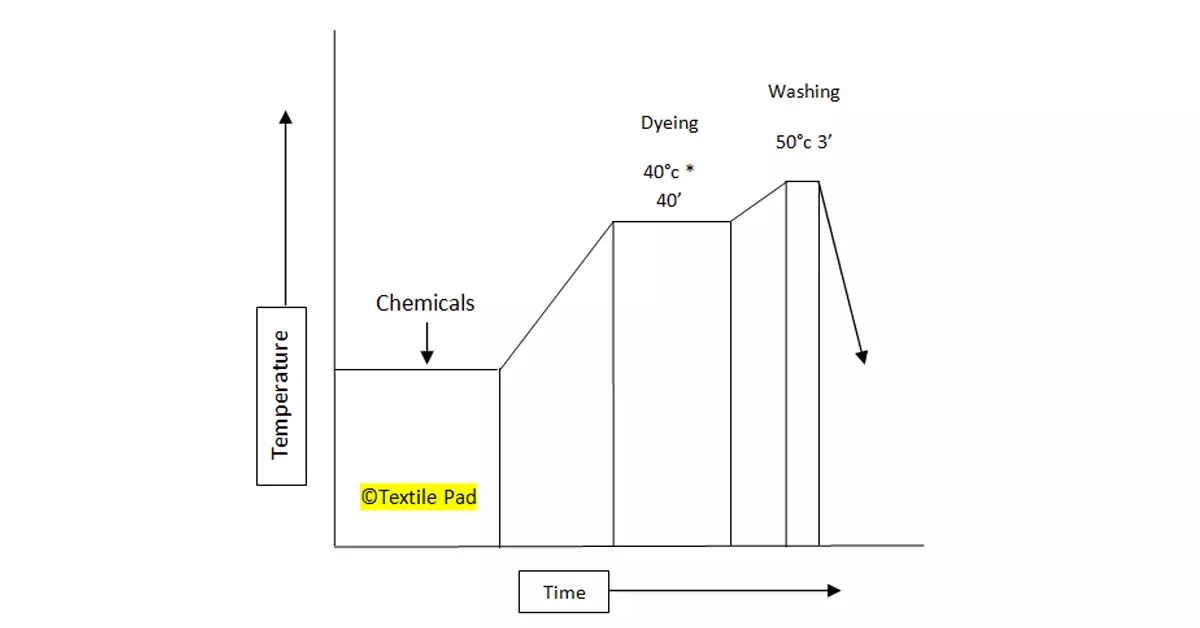 |
| Batik Dyeing Curve |
Precautions
- Must be careful during paste preparation.
- Carefully, the coating should be done.
- The calculation should be done carefully.
- Carefully maintain the time and temperature.
- Hot wash should be done carefully.
Conclusion
In some countries, batik-making is a tradition. Most notably, batik is considered a cultural icon in Indonesia. Different designs are possible to make with batik. The clothes can be worn on a daily basis for casual and formal occasions.
What is tie dyeing? What are the procedures for tie dyeing?
Ahmedabad